The AGI Debate of 2026: The Battle Over Essence, Path, and Power

In beginning of 2026, the world of artificial intelligence was rocked by an intellectual earthquake that would define its future. This tremor did not originate from a technical breakthrough, but from a public declaration of war aimed at the very core of the field's ambitions.
The AGI Debate of 2026: The Battle Over Essence, Path, and Power
Analysis of the LeCun vs. Hassabis Debate and Its Industry Impact |
Document Update Time: Jan 2026 AISOTA.com
Quick Navigation / Table of Contents
- Introduction: An AI Civil War Ignited by a Single Word
- Chapter 1: The Battle Over Goals — Is AGI the Next "Moonshot" or a "Perpetual Motion Machine" Scam?
- Chapter 2: The Battle Over Paths — The "Narrow Gate" and the "Shortcut" to Intelligence
- Chapter 3: The Battle Over Power — Musk's Gambit and the Titans' Chessboard
- Chapter 4: Echoes of History and the Fog of the Future
Introduction: An AI Civil War Ignited by a Single Word
In December 2025, the world of artificial intelligence was rocked by an intellectual earthquake that would define its future. This tremor did not originate from a technical breakthrough, but from a public declaration of war aimed at the very core of the field's ambitions.
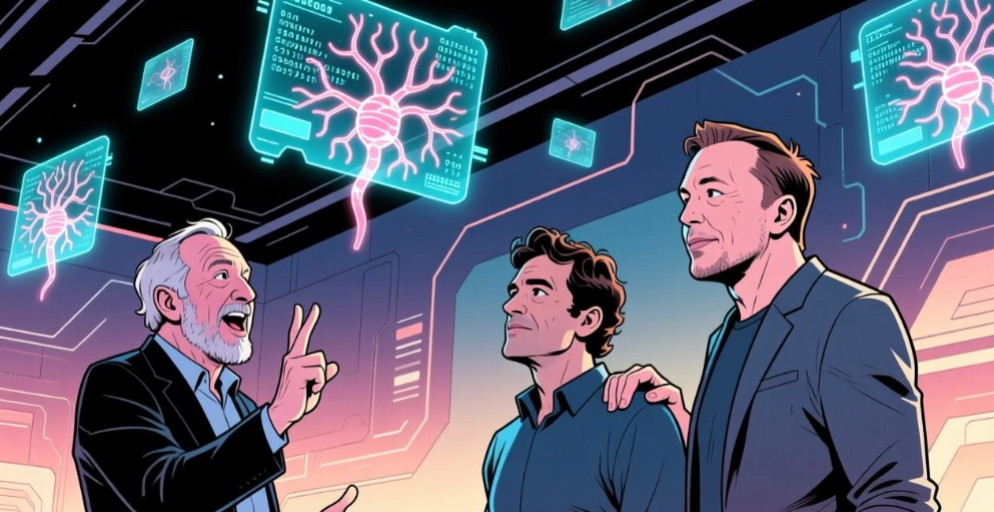
Yann LeCun, Chief AI Scientist at Meta and Turing Award laureate, dropped a bombshell in an in-depth interview: "Artificial General Intelligence (AGI) is bullshit." He argued that the industry's pursuit of AGI was a "human narcissistic delusion" built upon a flawed understanding of intelligence itself.
Within 24 hours, this "delusion theory" faced its fiercest rebuttal. Demis Hassabis, founder of DeepMind and renowned as a modern "AI alchemist," responded directly on social platforms: "This view is profoundly mistaken." He staunchly defended AGI not only as possible but as the most important engineering goal of our time, humanity's "next moonshot."
Then, another figure perpetually at the eye of the AI storm weighed in. Elon Musk offered a brief, unambiguous endorsement: "Demis is correct." The tech titan famous for warning that AI "could destroy humanity" surprisingly aligned himself with the AGI accelerationists.
One word—"bullshit." One retort—"profoundly mistaken." One endorsement—"he's correct." These three assertions, hurled into the public sphere in quick succession at the end of 2025, instantly ignited a global debate. This was no ordinary technical disagreement. It tore open the deep fissures beneath a surface of harmony, laying bare a triple-layered war over the nature of intelligence, the future of civilization, and the control of technology.
The core of this debate extends far beyond "how to build smarter machines." It forces us to answer more fundamental questions: What is intelligence? Is it the exclusive domain of a highly specialized "Swiss Army knife" like the human brain, or a potential that could emerge from any sufficiently powerful computational architecture? Is our ultimate goal an AI that is a "practical philosopher" with a deep, causal understanding of the physical world, or an "omniscient oracle" driven by infinite compute and data? And in this race to shape the future, will power reside with idealists championing open-source and democratization, or with giants controlling closed ecosystems and core resources?
This report will dissect this pivotal debate layer by layer. We will first delve into the "Battle Over Goals," examining the fundamental philosophical opposition between LeCun and Hassabis. We will then enter the "Battle Over Paths," comparing the "narrow gate" of world models with the "shortcut" of scaling laws. Finally, we will unveil the curtain on the "Battle Over Power," deciphering the logic behind Musk's unexpected alignment and how tech titans are placing their bets in this war to define our future.
This is a war about what kind of future we will create. The battle is already underway.
Chapter 1: The Battle Over Goals — Is AGI the Next "Moonshot" or a "Perpetual Motion Machine" Scam?
The debate at the end of 2025 was not initially about "how to achieve" but about "whether it is possible." The divergence between LeCun and Hassabis begins with the most fundamental philosophical understanding of the concept of "intelligence." This chapter analyzes this "battle over goals," combining their latest statements and actions from late 2025 to reveal the completely different worldviews behind them.
1.1 Yann LeCun: The AGI "Skeptic" and the Hard Return of a Specialized View of Intelligence
Entering 2025, Yann LeCun's critique of the "AGI" concept reached unprecedented clarity and intensity. In a year-end interview with MIT Technology Review in December, he systematically laid out his position:
"We need to stop talking about AGI. The term has been abused as a marketing gimmick, suggesting a form of 'general' intelligence detached from specific tasks and the physical world. But intelligence is always specific, contextual, and purposive. The intelligence a squirrel displays in storing nuts in a forest is a completely different adaptive system from the intelligence a human uses to play chess. To think we can abstract them into a universal 'measure of intelligence' is a fundamental misunderstanding."
Core Arguments and Supporting Data (2025):
- Argument: Human intelligence is a "highly specialized collection." LeCun repeatedly cites evidence from neuroscience and evolutionary psychology, arguing that the human brain is a modular system evolved over millions of years to solve specific survival problems (like spatial navigation, social cooperation, tool use).
- Argument: Current AI benchmarks are misleading. He argues that benchmarks like MMLU (Massive Multitask Language Understanding), seen as measures of AGI progress, only test "knowledge recall and pattern matching" in a narrow domain, far from true "understanding" and "general problem-solving ability."
- Action: Departure and a new venture. In mid-December 2025, LeCun announced he would leave Meta in early 2026 to found a new company, reportedly named Vesta AI. According to insiders, the startup secured over $200 million in initial funding with the sole mission of developing the "world model" foundational architecture he long advocated.
Philosophical Roots: LeCun's stance is rooted in theories of Embodied Cognition and Ecological Rationality. Intelligence cannot be abstracted as pure computation; it is a problem-solving package for efficient survival, co-shaped over eons of evolution by an organism's body and its environment. Therefore, there is no "general intelligence" detached from specific embodiment and environment.
1.2 Demis Hassabis: The AGI "Believer" and the Strong Defense of a Computational View
Facing LeCun's sharp critique, Demis Hassabis issued a comprehensive rebuttal through a series of posts and media interviews in late December 2025. His core argument: LeCun makes a "category error," confusing "general" with "universal."
"LeCun's view is based on an over-biologization of intelligence. But the core of intelligence is a process of information processing and pattern discovery. Once we have a sufficiently powerful computational architecture (like a Turing machine) and give it enough data and compute to learn, then its acquisition of broad problem-solving ability—general intelligence—is theoretically inevitable. The human brain is just one biological instance of this general architecture, not its definition."
Core Arguments and Supporting Data (2025):
- Argument: Evidence for "approximate generality" already exists. Hassabis points to DeepMind's own journey. From DQN playing Atari to AlphaGo mastering Go, to the Gato model handling protein folding (AlphaFold), mathematics (AlphaCode), and multiple games, the same architecture based on deep reinforcement learning and Transformers has shown remarkable cross-domain learning ability.
- Argument: Scaling laws are the "compass" pointing to AGI. He cites the "scaling laws" research, which suggests a predictable power-law relationship between training compute and emergent abilities. Hassabis sees this as providing an engineering roadmap for AGI: follow the scaling curve, and intelligence's "generality" will emerge.
- Action: Advancing the "Genie" project. As an alternative take on "world models," Hassabis's DeepMind published a technical white paper for the "Genie 3" project in November 2025. Unlike its predecessor, Genie 3 aims to learn to generate a highly realistic, interactive physics environment simulator from massive internet video and unlabeled robotics data.
Philosophical Roots: Hassabis's belief stems from Computationalism and Emergence Theory. He views the essence of mind as a computational process; with sufficient computing power and effective learning algorithms, complex, human-like, or superhuman intelligent properties can emerge from simple computational rules. The "generality" of intelligence is a natural product of complex systems reaching a certain scale.
1.3 The Core Dichotomy: A Tableau of Divergent Philosophies
To clearly grasp the "battle over goals," the table below contrasts the two visions of intelligence across multiple dimensions.
| Dimension | Yann LeCun's "Specialized Intelligence" View | Demis Hassabis's "General Intelligence" View |
|---|---|---|
| Intellectual Roots | Evolutionary Biology, Embodied Cognition | Computational Theory, Computer Science |
| Core Metaphor | "Swiss Army Knife": A set of highly efficient, purpose-specific tools. | "Universal Turing Machine": A programmable, general-purpose computational device. |
| Definition of AGI | A meaningless "pseudo-goal." Pursues a non-existent "universal intelligence." | A clear, achievable "North Star." A system with powerful learning & adaptation, reaching human-level across broad, untrained tasks. |
| View of Human Intelligence | Specialized product of evolution. Its strengths and limits stem from its specific history. | Proof of "general potential". Human cross-domain learning proves the brain's powerful general computational potential. |
| Key 2025 Action/Statement | Called "AGI is BS"; Announced departure from Meta to found Vesta AI. | Called LeCun's view "profoundly mistaken"; Published Genie 3 white paper. |
Thus, the landscape of the "battle over goals" becomes clear: one side, grounded in biological reality, declares AGI a conceptual trap and calls for a return to pragmatism; the other, rooted in computational theory, believes AGI is a historical inevitability to be pursued with full force. With goals diverging, the paths to achieve them naturally head in opposite directions. This leads us to the next, even more contentious battlefield: the Battle Over Paths.
Chapter 2: The Battle Over Paths — The "Narrow Gate" and the "Shortcut" to Intelligence
Goals determine paths. As Yann LeCun and Demis Hassabis diverged on the philosophical question of "whether general intelligence exists," the implementation paths they championed became a race unfolding across technical, resource, and temporal dimensions. This chapter delves into the core logic, latest practices, and fundamental conflicts of the "World Model" and "Scaling Law" technical routes.
2.1 LeCun's "Narrow Gate": The "World Model" Path Based on Physical Commonsense
For Yann LeCun, since "general" intelligence does not exist, the only legitimate path to advanced AI is to make it learn basic commonsense about reality from the physical world, much like a human infant or a higher animal. This path, which he calls building a "world model," is difficult and slow but is considered the only reliable route to robust intelligence.
Technical Core: Embodied Intelligence and Causal Learning
In a series of late 2025 speeches, LeCun outlined the "world model" as having three core layers. The revolutionary aspect is that it requires AI to learn a predictable, causality-internal simulator. For example, it must not only recognize "a cup is on the edge of a table" but also predict "if pushed, the cup will fall and shatter," understanding that "shattering" results from gravity, material brittleness, and other physical constraints.
Latest Practices & Data (2025):
- Early Direction of Vesta AI: Based on leaked early recruitment information and R&D roadmaps from December 2025, LeCun's new company, Vesta AI, is focusing on developing a "Physical Commonsense Benchmark Suite" and a "Large-Scale Multimodal-Embodied Dataset." Its goal for 2026 is to build a repository of over 1 million hours of real robot operation videos.
- Critical Data on "Scaling Laws": In November 2025, LeCun cited a study from Carnegie Mellon University on social media. It showed that when test tasks shifted from language understanding to multi-step physical reasoning, the performance drop of top-tier large models exceeded 40%. He argued: "Increasing compute can make models fabricate stories more fluently, but it cannot grant them the commonsense to understand why a screwdriver tightens a screw."
Fundamental Challenge: Why is the "Narrow Gate" so difficult?
The core bottleneck of this path lies in "data acquisition" and "sparse rewards." Unlike easily scraping trillions of text tokens from the internet, collecting physical interaction data requires expensive robot hardware and slow real-world operations. LeCun admits this is a "narrow gate" but believes it is the only way to build truly reliable AI that can collaborate seamlessly with the human physical world.
2.2 Hassabis's "Shortcut": The Emergence Path Guided by "Scaling Laws"
Contrary to LeCun's "catch-up" thinking, Demis Hassabis believes the current path represented by large Transformer models is fundamentally correct. He argues that by continuing to invest in data and compute along the exponential curve revealed by "scaling laws," the "generality" of intelligence will emerge naturally.
Technical Core: Scale, Emergence, and Simulated Environments
The cornerstone of Hassabis's path is "scaling laws"—the predictable power-law relationship between model performance and the amount of computation, data, and parameters used for training. His strategy is to maximize scale to catalyze "capability emergence." Concurrently, to provide a "playground" for AI to learn complex skills, he strongly advocates building generative simulation environments.
Latest Practices & Data (2025):
- DeepMind's Scaling Progress: According to a Q4 2025 industry analyst report, the compute resources used by DeepMind to train its flagship models grew at approximately 35% per quarter over the past 18 months.
- Genie 3: The "Simulator" Generating Infinite Worlds: The Genie 3 technical white paper published in November 2025 is a paradigm of the Hassabis path. It is no longer just an AI that can play games but a model capable of generating an interactive, basic-physics-abiding 2D or simple 3D virtual environment from a single image or short description. This means, in theory, generating infinitely diverse training environments for AI agents without manual design, fundamentally solving the problems of scarce and low-diversity training data. Hassabis calls it the "key to unlocking embodied intelligence potential," though this "embodiment" currently exists in virtual worlds.
Fundamental Challenge: The "Cliff" Ahead of the Shortcut
Critics of this path, including LeCun, point to several seemingly insurmountable "cliffs":
- The Energy & Cost Wall: The electricity required to train a top-tier model will soon surpass the annual consumption of a medium-sized country.
- Depletion of High-Quality Data: Publicly available, high-quality text, image, and video data on the internet is expected to be fully consumed by existing models within 2-3 years.
- The Illusion of "Understanding": Does improved model capability represent genuine "understanding" or exceedingly complex "pattern matching"?
2.3 Path Showdown: A Comprehensive Comparison from Philosophy to Engineering
The table below presents the core differences between the two paths.
| Dimension | LeCun's "World Model" Path | Hassabis's "Scaling Law" Path |
|---|---|---|
| Primary Driver | Deep understanding of causality & physics. | Scale expansion of data, parameters, compute. |
| Key Data Source | Real-world embodied interaction data (robot sensors, force feedback). | Internet-scale multimodal data (text, image, video, code) + synthetic/generated data. |
| Representative Projects | Vesta AI (startup), MIT-IBM Watson AI Lab physics reasoning projects. | DeepMind Gemini/Gato/Genie series, OpenAI GPT/o series. |
| Main Bottlenecks | 1. High cost & slow speed of physical data collection. 2. Danger & irreproducibility of real-world experiments. |
1. Unsustainable exponential growth in compute/energy costs. 2. Impending exhaustion of high-quality data. 3. Model unexplainability & "hallucination." |
| Key 2025 Development | Founded Vesta AI ($200M+ funding); Published Physical Commonsense Benchmark paper. | Released Genie 3 whitepaper; Next-gen multimodal model training compute increased ~35% YoY. |
Chapter 3: The Battle Over Power — Musk's Gambit and the Titans' Chessboard
When the choice of technical path becomes intertwined with the strategies of trillion-dollar commercial empires, national competition, and control over humanity's future, the debate between LeCun and Hassabis transcends labs and papers, escalating into a global "battle over power." This chapter reveals that beneath the philosophical speculation on the nature of intelligence and the comparison of technical paths lies a deeper game over resource allocation, rule-setting, and the direction of civilization.
3.1 Decoding Musk's Logic: Why the "Controller" Supports the "Accelerationist"
Elon Musk's public support for Hassabis in late 2025 was a move full of strategic calculation. To understand it, one must see that Musk's ultimate goal is not simply to win the AGI race but to "ensure any winner races within the safety framework he advocates."
Action Decoded: A Tripartite Power Play
- Building Hardware Sovereignty: In 2025, Musk's Tesla and xAI doubled down on AI chip and supercomputing investments. His in-house Dojo 2.0 chips began large-scale deployment. This means whichever software path wins will need to run on the computational foundation he controls.
- Shaping the Rules: In late 2025, Musk was among the few industry leaders invited to provide closed-door testimony to the U.S. Congress and the EU Commission on "Frontier AI Model Regulation." His core proposals included a "licensing system" for training models beyond a certain threshold.
- The Data Monopoly Advantage: Tesla's global fleet of over 5 million vehicles with full self-driving hardware generates nearly 10 billion frames of real-world video data daily. This is an irreplaceable asset for building a "world model." Musk holds "ace cards" on both paths: compute via xAI, and a physical data loop via Tesla.
3.2 Titan Alignments: Meta's "Ideal State" vs. Google's "Empire"
Behind the two masters are the vastly different core interests and strategic bets of their employers or affiliated companies.
| Dimension | Meta (The Soil for LeCun's Path) | Google / DeepMind (The Bastion of Hassabis's Path) |
|---|---|---|
| Core Business & Strategic Need | The Metaverse & next-gen social platforms: Require AI to understand 3D space, physics of virtual objects, and avatar social interaction—all dependent on a powerful "world model." | Search, Ads & Cloud Services moat: Need AI with the broadest language, knowledge, and multimodal understanding to provide precise answers, generate personalized ads, and attract developers as PaaS. |
| 2025 Key Move | Acquired top robotics simulation software firms; Increased investment in AR/VR hardware labs for a "virtual-physical" data loop. | Announced plans to invest over $100 billion in global data center construction over five years, largely for AI training/inference. |
| Open-Source Strategy | Aggressive Open-Sourcer: Continuously open-sources Llama model series. Aims to build the largest developer ecosystem around its stack to fuel its Metaverse vision. | Cautious Opener: Provides capability via API/cloud services, but keeps core model weights & training details proprietary to maintain a technology gap as its core moat. |
3.3 Open vs. Closed Source: A "Proxy War" for Technological Democratization
The LeCun-Hassabis debate, on a broader level, has evolved into an ideological war over whether AI power should be centralized or distributed.
- LeCun & The Open-Source Camp's Creed: He argues that locking AGI-level technology inside the black boxes of a few mega-corporations is a civilizational disaster. In an October 2025 speech, he proclaimed, "Open source is the only defensive fortification."
- Hassabis & The Closed-Source Camp's Reality: Institutions like DeepMind and OpenAI argue that for frontier models with unprecedented capabilities, there "must be a buffer period between capability unlocking and safe deployment" for rigorous safety alignment and red-teaming. Fully open-sourcing relinquishes this critical safety valve.
- National Choices: This debate influences national strategy. The updated EU AI Act in 2025 provided compliance convenient for "open-source foundational models," aiming to encourage a European open-source ecosystem. U.S. legislative discussions lean towards accepting arguments from closed-source giants, emphasizing export controls for "cutting-edge models," thereby consolidating the position of existing leaders.
3.4 The Future of Power: A Fractured AI World?
The likely outcome of this power struggle is not a single winner-takes-all but a "stratification" and "fragmentation" of the AI world:
- The Application Layer (Open-Source Dominated): A vibrant, low-cost, highly customized application development ecosystem serving vertical industries and long-tail needs.
- The Frontier Layer (Closed-Source Monopoly): Breakthrough-capability models tightly controlled by 2-3 trillion-dollar giants, served as "crown jewels" via high-margin APIs.
- The National Layer (Sovereign AI): Major economies full support domestic champions to ensure AI sovereignty in critical areas, forming geopolitically-based technology maps.
The personal ideological debate between LeCun and Hassabis thus serves as the prelude to this grand power restructuring. It forces all participants to confront the question: Are we building a digital centralized empire controlled by a few "deities of intelligence," or a distributed, democratic era empowered by countless "intelligent tools" for the masses?
Chapter 4: Echoes of History and the Fog of the Future
When we step back from the heated debate of the present and extend our view over a longer timeline, we find that the current clash between LeCun and Hassabis did not emerge from a vacuum. It is deeply rooted in the cyclical paradigm shifts and philosophical disputes that have characterized the history of artificial intelligence. This chapter situates the debate within this historical context, examines the shared bottlenecks all paths now face, and attempts to forecast the likely outcome of this race and the true arrival of AGI.
4.1 Echoes of History: From "Symbols vs. Connections" to "Understanding vs. Scale"
The current opposition between "World Models" and "Scaling Laws" is, in essence, a re-emergence and modernization of the core philosophical debate in AI history.
Round 1: Symbolism vs. Connectionism (1980s-1990s)
Symbolism (analogous to the "World Model" path): Held that intelligence hinged on the logical manipulation of and reasoning with abstract symbols. It pursued clarity and explainability but was crippled by the "knowledge engineering bottleneck" of formalizing all human常识 and proved brittle.
Connectionism (analogous to the "Scaling Law" path): Argued that intelligence emerged from the interconnected behavior of simple units (neurons). It excelled at learning and pattern recognition but was long relegated to the background as an unexplainable "black box" until compute power caught up.
Historical Outcome: Connectionism, in the form of Deep Learning, achieved overwhelming victory in the early 21st century with breakthroughs in compute and big data, becoming the foundation of modern AI.
Positioning the Current Debate
LeCun's "World Model" vision can be seen as a modern-day return to the core aspirations of Symbolism—explainability, causal reasoning, knowledge representation—but this time attempting to achieve them with connectionist methods (self-supervised learning). Hassabis's "Scaling Law" path represents the apotheosis and doctrinal extension of the prevailing connectionist paradigm.
History suggests that pure the debate over the route often ends in “paradigm fusion.” By late 2025, clear signs of fusion were appearing: DeepMind's Genie attempts to learn physics within a generative environment, while many "world model" research efforts use the Transformer as a base module. The value of the debate is that it propels both sides to evolve toward the other's strengths.
4.2 The Fog of Reality: The Great Walls Looming Before All Paths
Regardless of philosophical allegiance, the entire AI field faced a series of severe, objective bottlenecks by the end of 2025 that may dictate the pace of progress.
| Bottleneck | Specific Challenge (2025 Status) | Impact on "World Model" Path | Impact on "Scaling Law" Path |
|---|---|---|---|
| Energy & Compute Wall | Training a top-tier model's carbon footprint equals hundreds of U.S. citizens' annual total. An October 2025 Nature comment stated that at current trends, AI could consume 10% of global electricity by 2030. | High-fidelity physics simulation requires immense compute, limiting scale and precision. | Further exponential model scaling nears economic and environmental unsustainability. |
| High-Quality Data Exhaustion | Studies indicate high-quality linguistic data will be exhausted before 2026; image/video data faces a 2-3 year bottleneck. Synthetic data risks quality degradation and "model autophagy." | Collection of real physical interaction data is extremely slow and costly, the primary constraint. | Data scarcity may force a scaling ceiling, a turn to lower-quality/synthetic data harming capability. |
| Alignment & Safety Cliff | Ensuring AI goals align with complex human values grows exponentially harder with capability. Multiple 2025 "jailbreaks" show current alignment techniques are far from reliable. | Granting AI planning ability via a world model introduces novel verification challenges to ensure safety. | More powerful models carry higher risk of misuse or unpredictable "emergent" behavior, inviting harsh regulation. |
4.3 Conclusion & Outlook: When Will AGI Arrive? Who Will Prevail?
When Will AGI Arrive?
The answer depends entirely on the definition of "arrival."
- If defined as "achieving expert level in most tasks": Following Hassabis's scaling path, combined with better multimodal & planning algorithms, we might see clusters of "Narrow AGI" reaching and surpassing human experts in more domains within the next 5-10 years, though they may still lack deep cross-domain integration and understanding.
- If defined as "possessing stable, explainable, human-like commonsense & causal understanding": This requires fundamental breakthroughs in LeCun's "World Model" path. Given the foundational science difficulty and data acquisition bottleneck, this is a vision for "at least 10+ years" or more.
- The most likely scenario is a staged, hybrid arrival: In the early 2030s, we may see a "proto-AGI" built by the scalers—powerful but potentially brittle and risky. Achieving a robust, trustworthy "mature AGI" will necessitate incorporating the wisdom of world models, potentially pushing that milestone to the late 2030s or beyond.
Who Will Prevail? — Fusion, Not Conquest
The constraints of history and reality strongly suggest the ultimate victor will not be a pure LeCun or pure Hassabis path. The more probable outcome is a forced fusion.
- Short-Term (2-3 years): The "Scaling Law" path will continue to dominate, producing dazzling applications and commercial successes, but "hallucination" and energy problems will sharpen, prompting the industry to seriously seek "world models" as an antidote.
- Mid-Term (5-7 years): Fusion accelerates. Large models will increasingly try to integrate internal "small world model" modules for physics/causal tasks, while "world model" research will borrow scaling techniques. "World models based on large-scale pre-training" could become the mainstream architecture.
- Long-Term: We may arrive at a new, fused paradigm that gains broad knowledge through massive data and deep causal models of the physical/social world through carefully designed learning objectives and architecture. Today's "battle of paths" will then be seen as a necessary and productive prelude to that fusion.
The Ultimate Arbiters
The final arbiters of this debate are not academic peer reviewers or venture capital flows, but the laws of physics, the rules of economics, and the collective safety choices of human society. The energy bottleneck, data limits, and alignment difficult problem will cool fervent races, steering efforts toward more pragmatic, fused engineering solutions.
LeCun, Hassabis, and Musk each play an indispensable role in this grand narrative: the Critic, the Builder, and the Sentinel. The Critic prevents collective delusion; the Builder expands the frontiers of the possible with engineering marvels; the Sentinel constantly reminds us that the tool in our hand is becoming a artifact of incalculable power.
The arrival of AGI, therefore, is not merely a technical moment but will be a complex socio-technical event. Its timing and form depend not only on code and chips but on how we, amidst this ongoing debate, balance idealism and realism, efficiency and safety, openness and control. The debate that began with one word—"bullshit"—will ultimately inscribe the future epic of how humanity coexists with its own creation.
This article was written by the author with the assistance of artificial intelligence (such as outlining, draft generation, and improving readability), and the final content was fully fact-checked and reviewed by the author.